

![Sophomore Lily Bell posing as a player in the senior assassin game. Seniors participating in the game eliminate others by squirting them with a water gun, and can wear goggles for immunity against others. “People did have to go out and buy [water] guns, but most people have the googles at home, but you don’t even have to use a gun, you can use water of any sort,” senior Gwyn Christensen said.](https://ahstalonnews.com/wp-content/uploads/2026/05/unnamed-1-1-900x1200.jpg)
![The shadows against a captivating blue are a nod to the “Catch Me If You Can” musical poster, both for this performance and the blue from the Broadway show. The detectives in this scene are at shooting practice, in preparation for when they finally encounter Frank Abagnale Jr. “We always say our motto is ‘theater is a team sport,’ and really just emphasizing to our students that everyone is welcome in the drama department. There's always a role for you, whether or not, on stage or behind the scenes, in the costume shop, in the scene shop. [There are] all sorts of different things that go into bringing a show to life. So we love our drama hawks and welcome everyone to drama,” Drama Director Mollie Jo Blahunka said.](https://ahstalonnews.com/wp-content/uploads/2026/04/cmiyc-1200x800.jpg)
![Henry, Emily (2021). People we meet on vacation [Book cover]. Berkley Books. Image used under fair use for purposes of commentary and review. Haley, Brett (2026). People we meet on vacation [Movie poster]. Movie poster courtesy of 3000 Pictures and Temple Hill Entertainment. Made by Adilyn Hoop using Canva.](https://ahstalonnews.com/wp-content/uploads/2026/01/vacay1.png)

![Lockhart, E. (2025). We fell apart [Book cover]. Delacorte Press. Image used under fair use for purposes of commentary and review. The newest book in the “We were liars” collection was released Nov. 4.](https://ahstalonnews.com/wp-content/uploads/2025/11/wefell1.png)




![A Group of PEOPEL PE students and helpers set up an obstacle course during class. The “Amazing Race” unit had started in PEOPEL PE where the students and helpers got to compete in a variety of different activities and games. “We try our best to make [inclusion] a school-wide event, but it's just so much more different when you actually engage with the students hands-on and actually get to know them as people.” Sophomore Bree Christensen said. Photo Taken by Ada McNulty.](https://ahstalonnews.com/wp-content/uploads/2026/05/unnamed-12-1200x900.jpg)




This political story, dressed up as witches in the famous world of Oz, has caught the world’s attention. What started as a fantasy novel by Gregory Maguire, which became a popular Broadway musical in 2003, now has a complete movie adaptation as of this November.
AHS sophomore Corin Bubon summarizes, “Elphaba was like, ‘I want to meet the wizard because if I meet the wizard, then everybody’s going to like me, and I won’t be green anymore.’ But then, after meeting Galinda and becoming friends with her, she starts to accept herself.”
Each form of storytelling has its positives and negatives that impact the message that Maguire had initially intended. Encapsulating the themes of propaganda and trying to ‘make good’, it is difficult to determine which “Wicked” tells the story the best.
Major differences
The adaptations have many fascinating deviations from the original content, whether to simplify the story for the audience or make it more entertaining. For example, in the original story, Elphaba didn’t like the Wizard and how he was treating the “Animals” and “animals”.
There are two categories of animals, using capitalization to differentiate between the sentient and non-sentiant classes. “Animals” with a capital A refers to members of society, while “animals” refers to the rendition of the species we observe in our real world society.
However, to make the Wizards’ betrayal more impactful, Elphaba idolized him in the musical. This decision kept the story lighthearted in the first act, allowing for a more painful reveal that the leaders they loved were manipulating Ozians into believing they were good.
Galinda’s popularity, Elphaba’s magic, and the romance with Fiyero were all added to Act One or Part One of the adaptations to make the beginning more interesting.
In Maguire’s original work, Galinda was upper-middle-class, aspiring to make wealthy connections. Elphaba never took sorcery at Shiz University, and Fiyero never had an official relationship with Galinda, though it’s hinted at.
The second act of the musical has too many differences to count. Maguire had many more characters, plot lines, and twists that dragged the story on, while the musical cut to the point and made it more engaging for the audience.
Ironically, Part Two of the movie adds a lot of confusing and moving parts to make it more interesting. A lot of mini songs were added to fill in the space of the second movie. They were repeated melodies from the first movie used to introduce the audience to the new reality that this movie begins with.
“Wicked: For Good”
Act Two of the musical was arguably the most interesting for me. Though this didn’t initially translate into the film for me, it still honored the story beautifully.
Once the setup of the film was finished, I feel like the movie could’ve continued like the musical had. However, there became a useless tangent to the story where the Wizard’s song “Wonderful” was used to coerce Elphaba into joining forces with him again.
The Wizard doesn’t have the integrity to hold up his end of the bargain. It’s frustrating because both Elphaba from the musical and book would have never fallen for that. Book Elphaba is temperamental and stubborn in her beliefs, once the Wizard betrayed her, she would’ve never been inclined to trust him again.
Despite this, the entire film showed a beautiful Oz with intimate details. Each scene was set intricately but also with purpose. The camera tricks with the mirrors when Glinda is self-reflecting are so symbolic, and it’s a great use of the media to further the story, but also allows the message to remain.
The songs “As Long as You’re Mine” and “No Good Deed” were the best run throughout the movie, and the action was entertaining and easy to follow. This also followed the musical almost perfectly. It was emotional and very well done.
“Wicked: Part I”
The movie has all of the music from the musical, but there are more producers can create with a film. Computer-generated imagery (CGI) and the set can all be much more detailed compared to a 2D background and the limited props of a musical. That said, the film is practically identical to the musical from scene to scene.
“All the dancing scenes with the songs and the choreography look really cool. The CGI with Elphaba flying on her broom looks really good,” junior Quinn Roush and fan of the musical, said, “They took Oz and made it come to life almost.”
In the song “What is this feeling?” The movie cuts through various instances where the characters attempt to sabotage each other. This adds a lot more depth because the musical makes the hatred feel short-lived, while the movie can make it appear to spread over a longer period of time.
Glinda is often seen more negatively. Roush said, “I don’t like how Ariana Grande portrayed Glinda sometimes, because I feel like Kristin Chenoweth [the original Broadway actress] did a good job at making her bubbly, quirky, and fun.”
“I love Glinda,” Bubon said, “I wouldn’t say that Glinda was completely giving Elphaba a makeover. It was more just making [Elphaba] feel comfortable in the skin she’s in.”
Ariana Grande’s performance, displaying the growth in Glinda’s character, really accentuates the overall message; yes, Elphaba is portrayed as wicked, but Glinda isn’t evil either. She’s another person doing her best with the cards life dealt.
“Wicked” the musical
Musically, “Wicked” is a variety of contradictory songs. “What Is This Feeling?” and “Popular” animate and excite the rivalry and eventual friendship between Glinda and Elphaba, strategically burying the actual words behind the upbeat track.
“The notes that her character hits are crazy. and I feel like she’s just a relatable character,” Roush said, “[Elphaba] just doesn’t fit in, and it’s hard when you very noticeably don’t fit in.”
“Dancing Through Life” is another energetic song sung by Fiyero, a prince who gets kicked out of every school he attends, goes to Shiz University, and convinces all the students to have a party and to relax a little because “Nothing matters, but knowing nothing matters. It’s just life.”
“‘Popular,’ and ‘What Is This Feeling’ [are] really fun with all the contrasting colors and all the dances. But then… ‘Defying Gravity,’ I was crying,” Bubon said. “It was so powerful and [Elphaba] was finally stepping away from who she thought she wanted to be to who she thinks she should be now.”
These lighthearted and funny scenes help the climactic moment in Act One, where Elphaba decides to leave and defy the wizard. The seriousness in this scene is a stark contrast to when Galinda fainted earlier for comedic effect.
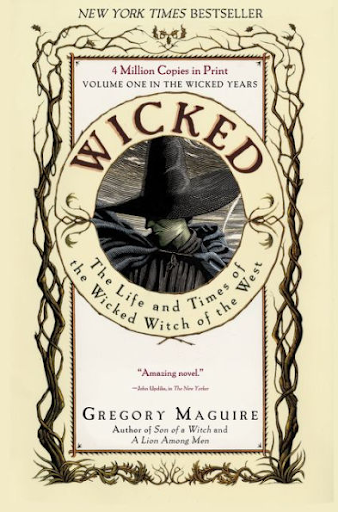
“Wicked” the book
Maguire wrote this piece intending to flip the narrative, asking why the wicked witch was evil. The musical and the movie lay this plainly in the present-day scene, where Glinda addresses the Ozians, “Is evil born or is evil thrust upon them?”
The book, however, begins with a long, almost boring description of Elphaba’s early childhood, where she would crush, grab, or destroy anything; the baby would claw at anyone who tried to put her in the bath, and her first word was “Horrors.”
This combination of uneasy tone and alarming adjectives works to curtain off the truth and allow the reader to imagine the truth on the blank drapes. That is the truth once it is assumed.
In the book, there are so many more places, characters, and vaguely described events that don’t happen in the musical or movies, and they are hard to follow. However, they all work to support the same message about tyranny.
“‘When times are a crucible, when the air is full of crisis,’ she said, ‘those who are the most themselves are the victims,’” Maguire wrote this dialogue from a mentor of sorts talking to Elphaba. This character does not appear in the musical nor in the movie.
Maguire wrote from many different perspectives, utilizing his omniscient narrator. Galinda has a whole section where the omniscient narrator zooms in on her, and we get to see Elphaba and Oz through her eyes.
“Galinda didn’t often stop to consider whether she believed in what she said or not; the whole point of conversation was flow. ‘Well, I didn’t mean to insult your father, for all I know, he is an entertaining and lively preacher.’ ‘No, I mean, do you think evil really exists?’ [Elphaba clarifies] ‘Well, how do I know what I think?’” wrote Maguire.
Elphaba helps Galinda actually think, to form an opinion about the world that isn’t simply to entertain someone into liking her.
Overall
“Wicked,” the novel birthed the story and message about corrupt government and misinformation; however, the musical communicated it through music and put it on a more public and literal stage for numerous years.
It should be acknowledged that the movie has popularized the story in a way the book or musical never could. This can be appreciated while also being aware of everything the musical and book accomplished.
That said, Maguire intended to spread the idea of ideas or forming one’s own opinion, and I believe that has translated through the many media forms commemorating his tremendous work of fiction.