





![Sophomore Lily Bell posing as a player in the senior assassin game. Seniors participating in the game eliminate others by squirting them with a water gun, and can wear goggles for immunity against others. “People did have to go out and buy [water] guns, but most people have the googles at home, but you don’t even have to use a gun, you can use water of any sort,” senior Gwyn Christensen said.](https://ahstalonnews.com/wp-content/uploads/2026/05/unnamed-1-1-900x1200.jpg)

![The shadows against a captivating blue are a nod to the “Catch Me If You Can” musical poster, both for this performance and the blue from the Broadway show. The detectives in this scene are at shooting practice, in preparation for when they finally encounter Frank Abagnale Jr. “We always say our motto is ‘theater is a team sport,’ and really just emphasizing to our students that everyone is welcome in the drama department. There's always a role for you, whether or not, on stage or behind the scenes, in the costume shop, in the scene shop. [There are] all sorts of different things that go into bringing a show to life. So we love our drama hawks and welcome everyone to drama,” Drama Director Mollie Jo Blahunka said.](https://ahstalonnews.com/wp-content/uploads/2026/04/cmiyc-1200x800.jpg)

![Henry, Emily (2021). People we meet on vacation [Book cover]. Berkley Books. Image used under fair use for purposes of commentary and review. Haley, Brett (2026). People we meet on vacation [Movie poster]. Movie poster courtesy of 3000 Pictures and Temple Hill Entertainment. Made by Adilyn Hoop using Canva.](https://ahstalonnews.com/wp-content/uploads/2026/01/vacay1.png)








![Lockhart, E. (2025). We fell apart [Book cover]. Delacorte Press. Image used under fair use for purposes of commentary and review. The newest book in the “We were liars” collection was released Nov. 4.](https://ahstalonnews.com/wp-content/uploads/2025/11/wefell1.png)









![A Group of PEOPEL PE students and helpers set up an obstacle course during class. The “Amazing Race” unit had started in PEOPEL PE where the students and helpers got to compete in a variety of different activities and games. “We try our best to make [inclusion] a school-wide event, but it's just so much more different when you actually engage with the students hands-on and actually get to know them as people.” Sophomore Bree Christensen said. Photo Taken by Ada McNulty.](https://ahstalonnews.com/wp-content/uploads/2026/05/unnamed-12-1200x900.jpg)










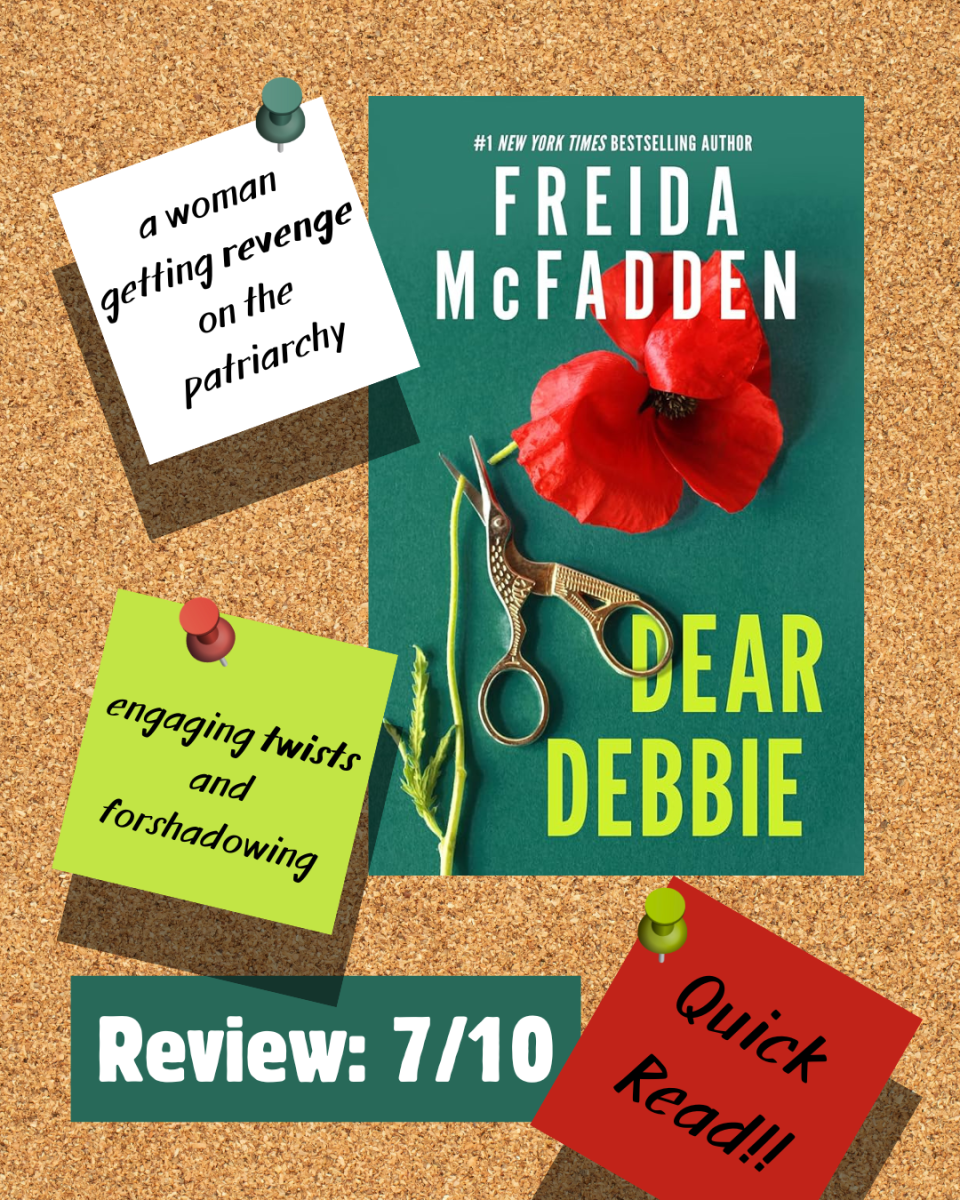
![Released Jan. 27, “Dear Debbie” takes the idea of a traditional housewife and lets her give in to the intrusive thoughts of revenge one wouldn’t expect from her role. McFadden, Frieda (2026) Dear Debbie [Book Cover] Poisoned Pen Press. Image used under fair use for commentary and review.](https://ahstalonnews.com/wp-content/uploads/2026/02/debbie1.png)
Debbie has roots in problem-solving; she was a gifted kid going to MIT, 178 IQ, and expected to be “the next Bill Gates” until she dropped out. Debbie later gets married to an accountant who becomes the sole provider for their family, but Debbie decides to pick up a part-time job writing an advice column for a small magazine anyway.
The story takes around three days, and from the main perspective of a housewife, I was surprised at how entertaining her days were. Debbie worked out, had a book club, and had a meeting with her boss.
Debbie’s boss uncharacteristically called her in for a chat, where she was fired. The paper was facing a lawsuit for advice she gave to a woman a few months ago. Around this time, McFadden has developed a pattern with the narrator; there’s an odd buzzing in her head in situations that feel unjust.
I think it’s a good way to explain the violent impulses Debbie has, but McFadden uses limited description. Her writing is very matter-of-fact that when it comes to writing tension, she has a formula. It works until the vocabulary and structure becomes repetitive.
“‘Trust me, Ken Bryant is going to regret letting you go. Deeply.’ Cooper seems a bit skeptical, but I know what I’m talking about. Sooner than he thinks, Ken is going to be sorry for what he’s done,” McFadden wrote.
This part is around a third of the way through the book, usually when the story is happening, and all of the seeds for the plot twist are buried. However, one thing about a lot of McFadden’s novels is the overflow of plot twists that are revealed one by one at the end. I liked “The Teacher” a lot for this reason.
McFadden continues to plant different varieties of flowers so the garden is clear and brilliant from the view of the last page. To do this, however, there are a lot of moving parts, dozens of characters, and that can make understanding lag.
It pays off because she combines the action and information-packed scenes with short chapters and multiple points of view. McFadden captures the perspective and reality of parent-child relationships through both Debbie and Cooper.
Debra and Cooper Mullen are married with two kids, Izzy and Lexi. Mother-daughter relationships seem to be a favorite for Freida McFadden, as her “Housemaid” series has similar themes of parent-child miscommunication.
Her kids don’t want her help, but Debbie finds ways to protect them regardless. When I was reading the parts where Debbie is going around solving problems and getting her revenge, her methods and results feel really sloppy. For example, Debbie is a big gardener; she grows opium flowers in her backyard and uses the drug for almost everything. If anyone suspected her or investigated her garden, she would be caught immediately.
Similarly, the careless nature of Debbie’s revenge on her book club, poisoning the sandwiches she made and proceeding to not eat them, was suspicious and clear to her friend Harley almost immediately. Her discrepancies are sloppy. Debbie blatantly admits that she had something to do with the horrible thing that happened to her daughter’s ex-boyfriend, but there were no consequences.
McFadden wrote, “Her face is buried in her hands, and her whole body is shaking with sobs… ‘But last night, you had a problem,’ I point out, “and now it’s fixed.’ Lexi looks up at me with her tearstained face, which is frozen in an expression of horror. ‘Not like this,’ she chokes out.”
This reminds me a lot of the tv series “Ginny and Georgia,” a young adult drama-comedy series on Netflix about a teen mom and her daughter, for whom she would do anything, even murder. The connection became clear to me when considering the lengths Debbie is willing to go to keep her kids safe. Lexi is a lot like Ginny, wanting comfort and security, and when her mom goes too far, she feels guilty.
The tension is a big driver of the plot, but so is McFadden’s writing style. She typically has shorter chapters and a few different perspectives to bounce back and forth between, but I especially liked it in this book.
In her previous books, the perspectives were unique and vaguely based on the characters’ values. Of the 7 books I have read by McFadden, I never felt or understood a character’s perspective the way I did in “Dear Debbie.” The three important narrators include Debbie, Cooper, and Harley. Cooper is Debbie’s husband, and Harley is a friend Debbie met at the gym.
Harley is dating a married man named Cooper. She has dated married men before, but Harley thinks she’s finally found the one. Her character is interestingly written because it’s so convincing and passionate, I feel how misguided she is.
“Cooper is the one. The more time I spend with him, the more certain I am that it’s true.” McFadden wrote later, “Cooper is the one. Every time I meet with him, I’m more sure of it.”
It’s interesting because McFadden writes flawed characters like Harley all the time, in “Do Not Disturb,” we get the killer’s twisted perspective too. Harley’s perspective is not rooted in reason or insanity; she is pure emotion that has gone too far. Repeating what she hopes is the truth in order to convince herself.
The story became less of a fantasy thanks to this angle because I could see the emotional damage and logic within Harley’s hurt. It’s more real that someone would feel these things and frankly, people do, unlike previous characters written by McFadden.
Daisy from “The Boyfriend” is so obsessively in love that it illogically leads to murder, Nina from “The Housemaid” is driven by a situation that seems impossible, and finally, Debbie goes on a rampage to fix everything in violence and frame jobs, fueled by rage and the protective nature of being a mother.
Despite multiple unrealistic factors, McFadden’s epic twists and deeper character development made this book a 7/10.