




![Sophomore Lily Bell posing as a player in the senior assassin game. Seniors participating in the game eliminate others by squirting them with a water gun, and can wear goggles for immunity against others. “People did have to go out and buy [water] guns, but most people have the googles at home, but you don’t even have to use a gun, you can use water of any sort,” senior Gwyn Christensen said.](https://ahstalonnews.com/wp-content/uploads/2026/05/unnamed-1-1-900x1200.jpg)

![The shadows against a captivating blue are a nod to the “Catch Me If You Can” musical poster, both for this performance and the blue from the Broadway show. The detectives in this scene are at shooting practice, in preparation for when they finally encounter Frank Abagnale Jr. “We always say our motto is ‘theater is a team sport,’ and really just emphasizing to our students that everyone is welcome in the drama department. There's always a role for you, whether or not, on stage or behind the scenes, in the costume shop, in the scene shop. [There are] all sorts of different things that go into bringing a show to life. So we love our drama hawks and welcome everyone to drama,” Drama Director Mollie Jo Blahunka said.](https://ahstalonnews.com/wp-content/uploads/2026/04/cmiyc-1200x800.jpg)

![Henry, Emily (2021). People we meet on vacation [Book cover]. Berkley Books. Image used under fair use for purposes of commentary and review. Haley, Brett (2026). People we meet on vacation [Movie poster]. Movie poster courtesy of 3000 Pictures and Temple Hill Entertainment. Made by Adilyn Hoop using Canva.](https://ahstalonnews.com/wp-content/uploads/2026/01/vacay1.png)








![Lockhart, E. (2025). We fell apart [Book cover]. Delacorte Press. Image used under fair use for purposes of commentary and review. The newest book in the “We were liars” collection was released Nov. 4.](https://ahstalonnews.com/wp-content/uploads/2025/11/wefell1.png)









![A Group of PEOPEL PE students and helpers set up an obstacle course during class. The “Amazing Race” unit had started in PEOPEL PE where the students and helpers got to compete in a variety of different activities and games. “We try our best to make [inclusion] a school-wide event, but it's just so much more different when you actually engage with the students hands-on and actually get to know them as people.” Sophomore Bree Christensen said. Photo Taken by Ada McNulty.](https://ahstalonnews.com/wp-content/uploads/2026/05/unnamed-12-1200x900.jpg)










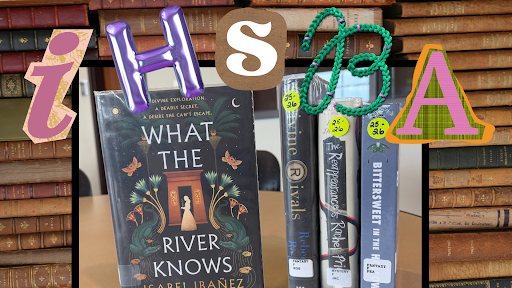
![An adventure story through Egypt with love, mystery, and betrayal. Ibañez, Isabel (2023). What the river knows [Book cover]. Wednesday books. Image used under fair use for purposes of commentary and review.](https://ahstalonnews.com/wp-content/uploads/2026/03/river1.png)
Isabel Ibañez captured the culture and tense historical nature of her story incredibly well, resulting in the story having gained recognition in the Iowa High School Book Award (IHSBA) competition.
Statewide recognition paired with immediate action and adventure, Ibañez immediately had my attention. The main character, 19-year-old Iñez, gets a letter declaring the deaths of both of her parents while they were in the deserts of Egypt. Iñez is going to discover what happened to them by venturing there herself.
Iñez lives with her aunt and her cousins in Argentina. Her parents knew her and raised her but never really stayed to permanently be a part of her life. They would leave her for adventures in Egypt more than they would be with their own daughter. Iñez was also driven to discover what they continuously chose over her.
Librarians in Iowa choose the best young adult (YA) books for IHSBA. “What the river knows” is one of the twelve chosen for the voting in the spring. The IHSBA-nominated books are then voted on by high school students all across Iowa.
The only requirements for voting are that you must be a high school student and you have to read one of the nominated novels by this March (2026). Voting ends on March 27th this year.

The nomination of “What the river knows” has some validity. Ibañez plotted an intense book loaded with twists and mystery, but I think there are better options.
The story arc is planned well enough for the main twists to be relatively impactful, it’s clear that high-energy scenes are one of Ibañez’s strengths. Although bleeding into the rising action, some of the minor moments were written in an overly dramatic manner, and most of the time it didn’t follow the logic from the previous scene.
The plot is entertaining, but the strongest part of this novel is the portrayal of culture. Specifically, the way language was written was my favorite part. I might be biased, because I love languages, but Ibañez communicated all aspects of language beautifully.
Iñez speaks Spanish, English, a little French, and she knows phrases in Egyptian Arabic. When the book takes place in 1884, Egypt was very multilingual. While she knows many languages, her lack of proficiency in French and Egyptian Arabic or other dialects slowed her down in the beginning in a very natural way.
The book chapter numbers are all in Spanish, and many A1 phrases of all of those languages are slipped into the dialogue to simulate the environment. A1 level is the base level of words for a language; it’s comprehensible to non-native speakers. I also liked the way language built up Iñez’s character. For example, Iñez wasn’t a traditional girl at the time; she would run away from her aunt, explore, and get dirty.
Her aunt didn’t tolerate any of this, especially swearing, so instead of saying a curse word in Spanish, she opted for a similar-sounding one: “Miercoles,” meaning Wednesday.
This is such a natural way language works, even when she would speak English, she would naturally mutter this substitution when she was frustrated. Language is portrayed very humanly; it is one of the most realistic parts of this story.
Language is handled delicately; the busy streets with words of many dialects mingling together in Cairo were some of Ibañez’s best descriptions. I could feel the chaos and beauty of the mixed cultures as I read. Although some adjectives did become repetitive. For instance, Iñez is an artist, and any moment she wants to draw, it would be described as an itch.
The story truly begins when Iñez steps off the boat in Egypt. She journeyed to see her uncle, her new guardian, and to learn the truth behind her parents’ deaths. She’s greeted by her uncle, Tío Ricardo, and Whit Hayes. They both remain vague in their accounts of her parents’ deaths, and a boat is already booked to take her back to Argentina.
Evading their plans multiple times and annoying Mr. Hayes, Iñez stubbornly refuses to give in and return to Argentina. They have a rough, clashing relationship. Whit is described as hardened by war, strong, and stoic. It’s unbelievable that he would fail so many times, especially after learning how determined Iñez could be. Mr. Hayes continued to fall short of his formidable, confident type.
“He walked away, cheerfully whistling. When he’d disappeared fully, I shut the door. I had minutes to make my escape. My pulse thrummed in my veins. I gathered my things: purse filled with piastres, my pencil and pad, parasol, and room key. Colette watched me, her eyebrows climbing up to her hairline and her jaw dropping at my quick movements. Before she could say or do anything, I slipped out of the room and promptly locked her in,” Ibañez wrote.
Mr. Hayes is portrayed so powerfully, but his efforts are easily evaded, with little creativity, each time. Colette is a barely mentioned woman who was randomly found to escort her back. In Whit’s eyes, this was foolproof somehow.
Another unlikely scenario and outcome was when Iñez was trying to disguise herself and hide on a boat, and a crew member of said boat helped her find clothes to be a stowaway on his own ship. The captain noticed the numbers were off and verbally denied caring. This is extremely out of character for both the reality of what the crew is doing and the facade: digging for artifacts.
The sharp veer from reality is a constantly turning road. Iñez’s inner monologue doesn’t always recite everything as she thinks it, so her actions can feel out of place. Being 19 in 1884, Iñez is overlooked and underestimated, but her dialogue is a cringeworthy attempt at rebelliousness.
Ibañez wrote the dialogue, “‘If you haven’t guessed,’ I began quietly, ‘I have a lot more in common with my parents than you might think. Like them, I like to discover the truth. Hidden things have always fascinated me. And you, Mr. Hayes, have a secret. It’s long since been buried, but I know it’s there. And one day, I will uncover it. Mark my words.’”
The ominous way the character draws out her words almost negates all tension when it’s a constant promise and little follow-through. However, the plot does a great job of highlighting the adventure and action.
Running around Cairo and Philae, finding secret letters, and discovering ancient tunnels, the storyline is brave and enrapturing when it finally gains momentum.
Overall, I give “What the River Knows” a 4/10 for being an entertaining adventure with a few discrepancies.