





![Sophomore Lily Bell posing as a player in the senior assassin game. Seniors participating in the game eliminate others by squirting them with a water gun, and can wear goggles for immunity against others. “People did have to go out and buy [water] guns, but most people have the googles at home, but you don’t even have to use a gun, you can use water of any sort,” senior Gwyn Christensen said.](https://ahstalonnews.com/wp-content/uploads/2026/05/unnamed-1-1-900x1200.jpg)

![The shadows against a captivating blue are a nod to the “Catch Me If You Can” musical poster, both for this performance and the blue from the Broadway show. The detectives in this scene are at shooting practice, in preparation for when they finally encounter Frank Abagnale Jr. “We always say our motto is ‘theater is a team sport,’ and really just emphasizing to our students that everyone is welcome in the drama department. There's always a role for you, whether or not, on stage or behind the scenes, in the costume shop, in the scene shop. [There are] all sorts of different things that go into bringing a show to life. So we love our drama hawks and welcome everyone to drama,” Drama Director Mollie Jo Blahunka said.](https://ahstalonnews.com/wp-content/uploads/2026/04/cmiyc-1200x800.jpg)

![Henry, Emily (2021). People we meet on vacation [Book cover]. Berkley Books. Image used under fair use for purposes of commentary and review. Haley, Brett (2026). People we meet on vacation [Movie poster]. Movie poster courtesy of 3000 Pictures and Temple Hill Entertainment. Made by Adilyn Hoop using Canva.](https://ahstalonnews.com/wp-content/uploads/2026/01/vacay1.png)










![Lockhart, E. (2025). We fell apart [Book cover]. Delacorte Press. Image used under fair use for purposes of commentary and review. The newest book in the “We were liars” collection was released Nov. 4.](https://ahstalonnews.com/wp-content/uploads/2025/11/wefell1.png)








![A Group of PEOPEL PE students and helpers set up an obstacle course during class. The “Amazing Race” unit had started in PEOPEL PE where the students and helpers got to compete in a variety of different activities and games. “We try our best to make [inclusion] a school-wide event, but it's just so much more different when you actually engage with the students hands-on and actually get to know them as people.” Sophomore Bree Christensen said. Photo Taken by Ada McNulty.](https://ahstalonnews.com/wp-content/uploads/2026/05/unnamed-12-1200x900.jpg)












On June 28, 2024, the Supreme Court made two monumental rulings that would forever change the way courts view cases. Chief Justice Clarence Thomas wrote the majority opinion on Loper Bright Enterprises v Gina Raimondo and Relentless Inc. v Department of Commerce that threw out an over 50-year-old precedent called Chevron Doctrine. But what is Chevron Doctrine, and why does it matter?
Chevron Doctrine is named after the 1984 case Chevron v. Natural Resources Defense Council, in which the court ruled that laws were created ambiguously for courts to call on expert agencies to provide input. This came after Congress passed the Clean Air Act, which required companies to submit a permit every time they made a new stationary source of pollution. The Carter and Reagan administrations differed in their opinions on the law, as Reagan was much more lenient. Justice John Paul Stevens wrote the unanimous opinion of the court that helped define Chevron Deference.
Chevron is a two-part test to test the legality of an Executive Agency rule. First, courts looked at the rule to see if it was ambiguous. If there was, the agency was allowed to create rules to fill in the ambiguity. Then the court would look at if the interpretation of the rule is reasonable, and if it was not, the courts would force the agency to rewrite it to make it more reasonable.
Justice Stevens wrote in the opinion that judges are not experts and are therefore unable to speak on the rules unless they are unconstitutional. For example, imagine you are suing someone for destroying $10,000 dollars worth of property such as jewelry. Now, normally you would want to bring in someone who can describe the value of the jewelry and give an accurate estimate of it. However, this new ruling has made it so the judge now gets to decide how much the item is and they decide that every one of the jewels is fake and throws out your lawsuit.
So, what happens now? Well, per lawyer and content creator TheLegalEagle, the original ruling was cited in over 18,000 cases. This now means that all of these cases can be reopened and possibly have a changed ruling. Not only that, it drastically changed the way agencies can enforce their rules. This effectively removes one of the biggest checks the judicial branch has with its rulings.
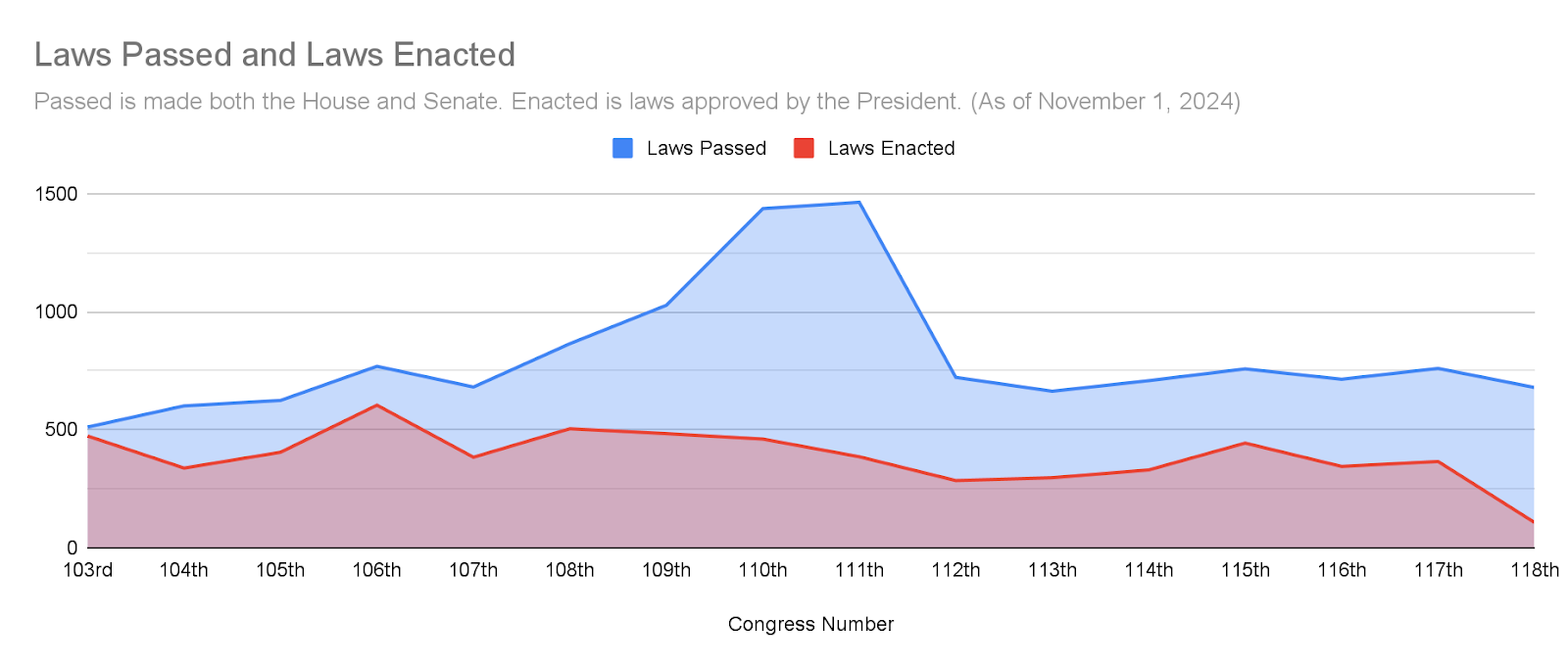
Another issue that will arise is that now courts can effectively make laws. With this Congress set to pass the fewest laws through its chambers, executive orders have become much more powerful. As Chevron has been overturned, the door is now open to challenge executive orders to a conservative Supreme Court without worrying about expert agency input.
The chart below illustrates the effectiveness of each congress since 1993. According to GovTrack, this congress is set to be the least effective congress since 1993.
Supporters of this ruling have applauded it as getting rid of government overreach and keeping the separation of powers. They also see it as a way to remove government interference from court proceedings. Justice Neil Gorsuch argued in an opinion that Chevron is a “doctrine for the abdication of the judicial duty,” as quoted in the Washington Post.
In all reality, this is a power grab by the court to gain power and expound the power of the president and itself while decreasing the power that Congress has. Justice Antonin Scalia writes in the Duke Law Journal that in his view, the rationale behind Chevron is akin to the reasoning used in earlier cases that also deferred to agency legal interpretations. He referenced a ruling from the First Circut Court that states that the degree to which courts should defer to agency interpretations depends on Congress’s intent as revealed by the specific statutory framework at issue.
Justice Elena Kagan read out a summary of her dissenting opinion from the bench stating that the court gave, “itself exclusive power over every open issue — no matter how expertise-driven or policy-laden — involving the meaning of regulatory law,” reports the Scotus Blog.
This decision has just made the courts a key weapon to overrule agency interpretations of laws and remove a key check. This has allowed judges to make themselves experts in fields they do not know of, but will instead rule in favor of their interests or beliefs. The effects will be rippled across the entire justice system, and have drastically changed the landscape of lawmaking.