






![Sophomore Lily Bell posing as a player in the senior assassin game. Seniors participating in the game eliminate others by squirting them with a water gun, and can wear goggles for immunity against others. “People did have to go out and buy [water] guns, but most people have the googles at home, but you don’t even have to use a gun, you can use water of any sort,” senior Gwyn Christensen said.](https://ahstalonnews.com/wp-content/uploads/2026/05/unnamed-1-1-900x1200.jpg)

![The shadows against a captivating blue are a nod to the “Catch Me If You Can” musical poster, both for this performance and the blue from the Broadway show. The detectives in this scene are at shooting practice, in preparation for when they finally encounter Frank Abagnale Jr. “We always say our motto is ‘theater is a team sport,’ and really just emphasizing to our students that everyone is welcome in the drama department. There's always a role for you, whether or not, on stage or behind the scenes, in the costume shop, in the scene shop. [There are] all sorts of different things that go into bringing a show to life. So we love our drama hawks and welcome everyone to drama,” Drama Director Mollie Jo Blahunka said.](https://ahstalonnews.com/wp-content/uploads/2026/04/cmiyc-1200x800.jpg)
![Henry, Emily (2021). People we meet on vacation [Book cover]. Berkley Books. Image used under fair use for purposes of commentary and review. Haley, Brett (2026). People we meet on vacation [Movie poster]. Movie poster courtesy of 3000 Pictures and Temple Hill Entertainment. Made by Adilyn Hoop using Canva.](https://ahstalonnews.com/wp-content/uploads/2026/01/vacay1.png)









![Lockhart, E. (2025). We fell apart [Book cover]. Delacorte Press. Image used under fair use for purposes of commentary and review. The newest book in the “We were liars” collection was released Nov. 4.](https://ahstalonnews.com/wp-content/uploads/2025/11/wefell1.png)










![A Group of PEOPEL PE students and helpers set up an obstacle course during class. The “Amazing Race” unit had started in PEOPEL PE where the students and helpers got to compete in a variety of different activities and games. “We try our best to make [inclusion] a school-wide event, but it's just so much more different when you actually engage with the students hands-on and actually get to know them as people.” Sophomore Bree Christensen said. Photo Taken by Ada McNulty.](https://ahstalonnews.com/wp-content/uploads/2026/05/unnamed-12-1200x900.jpg)










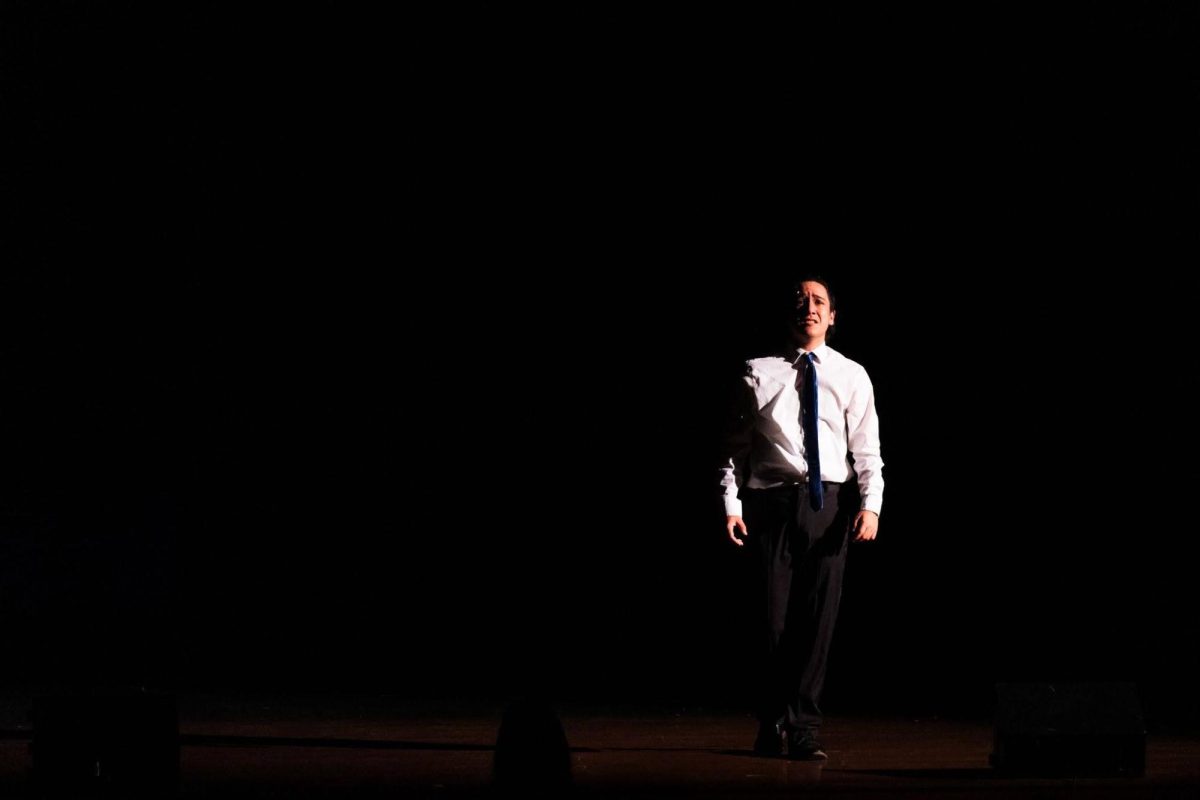
Walking into Fisher Theater, I could not have guessed exactly what I was getting myself into with Iowa State Professor Brad Dell’s adaptation of Julius Caesar.
The Tragedy of Julius Caesar (often shortened to Julius Caesar) is a Shakespearean play from 1599 that tells the story of the assassination of the ruler of Rome, Julius Caesar. It shows not only how the coup of assassins plotted their uprising, but also the brutal aftermath that follows as Rome crumbles when it loses its leader.
Dell immediately immerses the audience with not only the modern-day costumes, but interactive chanting and audience participation. With the audience cueing the very first actor entrance in the entire performance, it begins the impression held through the entire piece that the audience serves as roman citizens. Sitting in the purple seats the audience feels as if they are a part of the masses of Rome, torn between rulers and powers.
Although the audience bears the weight of the roman people, this adaptation compresses the over 20 citizens in Shakespeare’s original work into one character: the Soothsayer. Played by Ankeny High School Alum Jett Tyler (‘25), the Soothsayer warns Caesar about the ides of march in the first scene traditionally, but in this production he serves as the embodiment of the common man, pushed aside by the figures fighting to have power and serve him.
The choice seems powerful at times, and others unnecessary. In the beginning, the soothsayer feels powerful, leading the crowd in chants of “Caesar!”, while other times his movements through the performance space seem fruitless, not adding a new texture or meaning to the piece like his features in early scenes did.
One character that did command the stage every second they stepped into the space was definitely Abigail Keeton’s Marcus Brutus. Brutus enters the stage wearing her navy suit coat proudly, and dies upon it stripped of her love, clarity, and the image surrounding that suit coat. There was no way that a single person in the audience could look away from Keeton’s funeral address, filled with passion and a fire to make the audience believe that she is justified in killing the precious Caesar.
The play runs around 95 minutes, meaning that Dell has cut almost an hour from the original piece, but it works. The audience can truly interpret the story through both the condensed plot and the Shakespearean English, proudly showcasing the intense emotional work that has gone into this piece from the actors. I constantly found myself lost in the words, but enthralled with the pure emotion being shown on stage.
Portia usually can be cast aside as just Brutus’ wife, but Christy Salcido leaves an impression that remains bold in the audience’s mind well after she has died. Her intense fight with Brutus showcases not only her acting chops, but how Portia influences Brutus. The change in Brutus’ character after her passing is evident in both her quick ability to challenge her brother Cassius, but also her physical appearance. Her war sash wilts as she declares that Portia has died, allowing the audience to see Brutus wilt from her powerful and aggressive personality showcased at the climax of the play.
Jordan Harvey’s portrayal of Julius Caesar commands every step he takes in the golden hues of his spotlight. It is no wonder he has portrayed similar show stoppers like Sweeney Todd from Sweeney Todd and Hades in Hadestown. His booming stage presence can only be topped by Brutus, subtly foreshadowing Caesar’s downfall.
The technical aspects look sparse at first glance, but seamlessly enhance the actor’s portrayals.
The lighting easily tells the audience just where to look, how to catch the quick exchanges that soon snowball into an assassination. Even the off-stage lighting cues easily tell what is just beyond the view of the seats, ranging between a gate leading to an estate, or a vicious battle waiting to envelop the coup. The warm lighting that follows Caesar tells us what to expect from his rule, while Brutus’ violet and red lighting shows her divergence from Rome’s current ruling.
The use of a single costume per character at first seems like just a casualty from the short run time, but the careful precision in those costumes transforms the characters visually to fit their emotional changes. As the characters lose their polish and their government, it is easily mirrored by characters losing costume pieces, wrinkling their tight suits, and covering them in the blood of their adversaries.
This performance was technically a “staged reading”, meaning that the actors had their scripts on hand, but in matching the bold and new age suits that the characters adorned, they held ipads as their references. This choice could have gone really wrong, but it truly tied the whole look of the show together. Seeing the characters attached to their devices gave the same vibe as Lex Luthor in Superman or Seneca Crane in The Hunger Games, overseeing people while relying on their technology to govern them. Not every Shakespeare show presented in modern day staging works, but this choice was actually the cherry on top of a seamless adaptation (and added some cool effects to eye-catching scenes).
College theatre feels like such a growing pain on the outside, stuck between the youth of high school and the reality of the theatre industry. This production tells a story of embracing the time that college gives young thespians, allowing them to make choices that they will learn from. This production was full of choices, and they work together effortlessly to make an emotional and intense theater experience that I would recommend to anyone. Grab a friend and drive up I-35 North to the Fisher Theater and to see true theatrical art.
Julius Caesar runs October 3rd and 4th at the Fisher Theater in Ames, October 6th at The Little Book in Des Moines, and October 7th at Salisbury House and Gardens in Des Moines, Iowa.
For more information, visit the Iowa State Department of Music and Theatre website.

![Abby Jimenez’s newest novel was released on March 24, a forbidden romance between a man and his best friend's girlfriend. [Graphic by Adilyn Hoop using Canva] Jimenez, Abby (2026) The Night We Met [Book Cover] Forever, Hachette Book Group. Image used under fair use for commentary and review.](https://ahstalonnews.com/wp-content/uploads/2026/04/unnamed-5.png)