


![Sophomore Lily Bell posing as a player in the senior assassin game. Seniors participating in the game eliminate others by squirting them with a water gun, and can wear goggles for immunity against others. “People did have to go out and buy [water] guns, but most people have the googles at home, but you don’t even have to use a gun, you can use water of any sort,” senior Gwyn Christensen said.](https://ahstalonnews.com/wp-content/uploads/2026/05/unnamed-1-1-900x1200.jpg)

![The shadows against a captivating blue are a nod to the “Catch Me If You Can” musical poster, both for this performance and the blue from the Broadway show. The detectives in this scene are at shooting practice, in preparation for when they finally encounter Frank Abagnale Jr. “We always say our motto is ‘theater is a team sport,’ and really just emphasizing to our students that everyone is welcome in the drama department. There's always a role for you, whether or not, on stage or behind the scenes, in the costume shop, in the scene shop. [There are] all sorts of different things that go into bringing a show to life. So we love our drama hawks and welcome everyone to drama,” Drama Director Mollie Jo Blahunka said.](https://ahstalonnews.com/wp-content/uploads/2026/04/cmiyc-1200x800.jpg)

![Henry, Emily (2021). People we meet on vacation [Book cover]. Berkley Books. Image used under fair use for purposes of commentary and review. Haley, Brett (2026). People we meet on vacation [Movie poster]. Movie poster courtesy of 3000 Pictures and Temple Hill Entertainment. Made by Adilyn Hoop using Canva.](https://ahstalonnews.com/wp-content/uploads/2026/01/vacay1.png)







![Lockhart, E. (2025). We fell apart [Book cover]. Delacorte Press. Image used under fair use for purposes of commentary and review. The newest book in the “We were liars” collection was released Nov. 4.](https://ahstalonnews.com/wp-content/uploads/2025/11/wefell1.png)








![A Group of PEOPEL PE students and helpers set up an obstacle course during class. The “Amazing Race” unit had started in PEOPEL PE where the students and helpers got to compete in a variety of different activities and games. “We try our best to make [inclusion] a school-wide event, but it's just so much more different when you actually engage with the students hands-on and actually get to know them as people.” Sophomore Bree Christensen said. Photo Taken by Ada McNulty.](https://ahstalonnews.com/wp-content/uploads/2026/05/unnamed-12-1200x900.jpg)









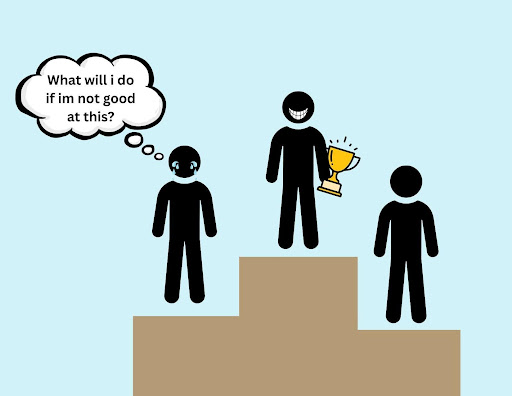
Imagine that it’s a normal school day. You’re sitting in one of your classes, daydreaming while the teacher rattles on about the subject. From the corner of your eye, you spot two students whispering, their eyes glancing over to you as they laugh. You try to push down that feeling of isolation and dread, but this isn’t the first time something like this has happened. These are the same students who started that rumor, and the same students who call you names when you’re just close enough to hear. This treatment is nothing new.
While bullying has decreased in the last few decades, it still remains a problem in schools. The National Center for Education Statistics (NCES) reports that nearly 20 percent of students in their teens have experienced bullying.
“I think people have mixed up what bullying is. It’s not like ‘80s high school movies,” junior Gabby Williams said. “The jock isn’t going to steal your lunch money. It can have real effects.”
Reportedly, when some people think of bullying, they often think of physical violence. While this can be true at times, many students think the most common types of bullying are online, verbal, and emotional.
Williams says that physical bullying is not as common as people think, “I think a lot of it is mental and emotional,” she said.
Mental and emotional bullying can look like spreading rumors, using derogatory names, or isolating others.
“I feel like, specifically with girls, it’s the silent excluding, it’s the very subtle stuff that a lot of times adults don’t catch, but we know that can create anxiety,” Ankeny High School counselor Kelly Andrews said.
Mentors in Violence Prevention
As bullying has evolved, it has become more difficult to spot. This is one of the reasons Ankeny implemented the Mentors in Violence Prevention (MVP) program. MVP was originally created at Northeastern University by Jackson Katz in the 1990s. This program was implemented at Ankeny High School (AHS) in the 2024-2025 school year.
“I think it’s helpful for us to create opportunities for students to have discussions and dialogues regarding real things that are actually happening,” Andrews stated.
Andrews is one of the current leaders of MVP. She works with students who are MVP mentors who contribute to MVP by giving presentations twice a month during Hawk Time about a specific topic.
“I like the MVP program a lot from the education standpoint. I like that it doesn’t shy away from those rough topics,” Williams said. “We talk about suicide. We talk about sexual violence and the actual consequences that come from bullying.”
MVP attempts to cover a variety of difficult topics that teens can face, such as dating violence, sexual assault, and bullying. But no matter the topic, they work to educate others.
“Number one, it’s to create awareness,” Andrews said. “Our [MVP] goal is to help students move on the bystander continuum to going from being oblivious to it, to becoming aware of it, then teaching students very specific options of how to respond.”
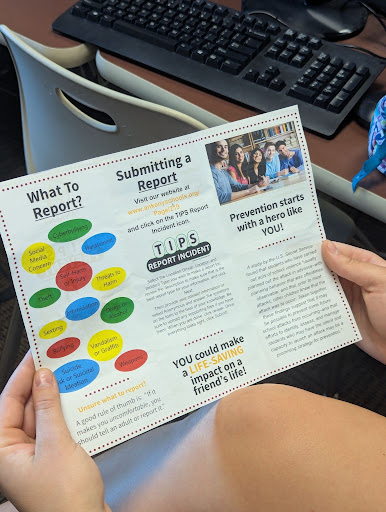
One of the responses to bullying is the TIPS reports. These online reports can be completed anonymously, allowing students to feel safe expressing any safety concerns they might have. TIPS reports can also provide data to determine how effective the MVP program is in creating upstanders.
“One thing that we have noticed, and one thing that we do have data on, is let’s say there is a situation that happens in the lunchroom. Instead of maybe one TIPS report coming in, we have multiple TIPS reports coming in about the same incident,” Andrews said. “So it’s not like incidents are increasing, but we have noticed and seen data that more people are using the tools that we have to report incidents.”
However, some students still remain hesitant about the effectiveness of MVP, especially when it comes to the guided discussions about the topics during the presentations.
“When they [students] answer questions or share their thoughts [during Hawk Time MVP lesson], they’re just saying what the MVP leaders want to hear,” sophomore Lyla Beaman said. “People don’t like the MVP lessons…They just want to get it over with. So if they say the perfect answer the first time, then it gets over faster.”
Another thing that students mentioned wanting to see MVP change is the way they structure the conversations around bullying.
“I think the school needs to shift, and I think the MVP program is a great step, but they need to shift their attitude towards bullying education from identification to action,” Williams remarked.
Actions against bullying
Besides prevention programs, the school also tries to help those who have been victims and put a stop to bullying through disciplinary measures. However, the school can only help with bullying they are aware of, and some students are hesitant to report it. This can be for fear of repercussions from the bullying, but sometimes it’s because they seemingly don’t think the school will do much to help.
“They [The school district] care a lot more if it’s physical, if it’s publicly physical, because then that’s a lawsuit. But if it’s not physical, it’s more like ‘well, you weren’t in any physical danger, so you’re fine,’” Williams said.
The counselors are aware that students have doubts about the impacts of bullying. However, the sooner students begin to report it, the more evidence there will be that it is a repeated incident.
“A lot of the time I’ll hear students like ‘well, nothing’s going to happen,’” Andrews explained. “But it’s kind of like if you get pulled over for speeding. You’re right, you might get a warning the first time, but if you get pulled over again, that’s going to be a ticket.”
Documentation is important when it comes to how the students involved in bullying will interact with each other post-incident. The school will rearrange schedules to support the victim if they have received the necessary reports and information.
“I’ve had a kid come in and say, ‘I actually can’t be in this class with this person.’ If there is no documented safety plan or anything like that, then the victim might be the one who has to drop the class,” Andrews said. “Whereas if a person has documented this, has talked with administrators, maybe we have a plan in place where we are able to say, these students should not be scheduled [together]. Then, because we’ve gone through the appropriate channels, the person who’s bullying might not be able to take a class if the victim is already in that class.”
The staff is prepared to make AHS as welcoming as possible for all students and allow them to feel safe in class. This is made easier by the minimal reports of bullying.
“Bullying is something that, I’m not naive to it, there is always some semblance of it in a school building. But I think that this building is fairly inclusive in terms of people trying to see the best in one another,” AHS Assistant Principals, Kyle Reeping, remarked.
Bullies and victims
While Ankeny is reportedly a welcoming school, it can still have issues with accepting different groups of people. In some cases, this can lead to bullying.
“Students at this high school are reflective of what goes on in the greater society of Iowa and the United States. If that’s the case, we’ve got some work to do with groups to make them feel included and safe,” English teacher Jim Cowger explained.
Students who are part of a minority group are more likely to experience bullying. For example, Pew Research reports that LGBTQ+ students are over twice as likely to experience bullying. In addition to this, students with disabilities are also common victims of bullying. Multiple students discussed witnessing increased bullying for students with disabilities at AHS, both visible and not.
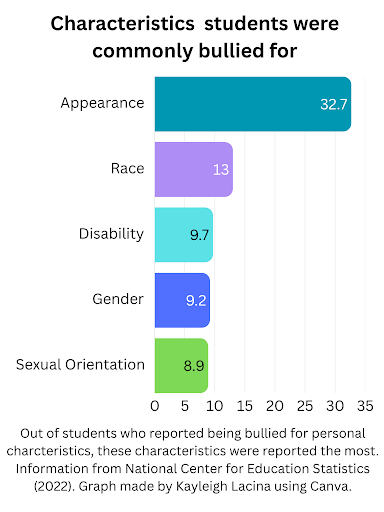
“Disabilities come in many forms, and they’re not always visible. And I think people have realized that if a person is not extremely physically disabled, then they feel like they can get away with it,” Williams said.
Some students may feel that teachers don’t notice or choose to ignore bullying. This can be especially true in situations where the bully and staff member are close. In those situations, many students have noticed a blind spot.
“Some people [seem to] kind of have immunity when it comes to bullying,” Beaman said.
Whether it’s that teachers are unaware of the bullying done by students, or if they’re just looking the other way, it can cause harm when not addressed. Sometimes, it can seem like the school itself has a bias.
“Unfortunately, it really does depend on who you’re getting bullied by, because if it is someone the school deems as valuable, they’re not going to do anything. I had situations where I’ve been bullied by two different people, and the school cracked down on one of them because he was a senior, and it was like, ‘you’re moving on, who cares?’ The other was a current junior, and they didn’t do anything because they [AHS] needed them for next year,” Williams said.
This bias and consequential lack of action from teachers and school staff can cause doubts in students about the effectiveness of AHS’s anti-bullying policies.
“I think the school has obviously been trying to do better, and I think that they still can do better. Specifically, I think the school needs to take it more seriously,” Williams continued.
The school has been trying to improve how they deal with bullying. This includes looking into common causes of bullying.
“I think what leads to bullying looks different for every student. Ultimately, there is either a miscommunication or a disagreement about an action or words said. I feel like that’s pretty common,” Reeping said. “But I also want to say that I think bullying sometimes is a peer conflict, where there’s been no resolution or no finality to it or understanding of coming to a compromise.”
Reportedly, students agree that peer conflicts or problems within friendships can create a toxic environment at school. However, they seem to feel that it is more of an ongoing experience rather than being because of a previous conflict.
“I see a lot of fake friendships. I’ve seen people who are best friends, I’ve seen Instagram posts with these people together… And then the next day at school, I hear this person saying the meanest things I’ve ever heard,” Beaman said.
Friendships are normally positive experiences, but sometimes they can become harmful and inauthentic. These relationships could then escalate into bullying. Another way friendships could contribute to bullying is by encouraging each other to bully. Typically, friendships bring out the best in one another, but occasionally, they can bring out the worst.
“In some cases, I feel like it’s how friends bond or interact. They find one person to target, and then that’s like their friend group’s goal. They turn it into an inside joke,” Beaman said.
Cyberbullying
The largest change that has occurred is the use of social media and its involvement in bullying. As social media has grown and become more and more common among teenagers, it has also become more prevalent in conflicts.
“Social media, the ease of access, and the ability to communicate with large groups, are primarily involved in any disagreement in some way, shape, or form,” Reaping said. “Very rarely is it just an in-person disagreement. It almost always involves some type of social media or communication app.”
The National Bullying Prevention Center reports that the number of teens who have experienced cyberbullying has risen from 18.8 percent in 2007 to 54.6 percent in 2023. As cyberbullying becomes more common, many people try to blame it on the appeal of being anonymous, but some students disagree about whether that influences the amount of cyberbullying.
“I think that the school definition of cyberbullying is not accurate to what it actually looks like. Yes, it gives the ‘this person can’t see me,’ but they’re not stupid. They know that if push comes to shove, it will get back to them,” Williams remarked.
Whether it’s cyberbullying, physical bullying, or verbal bullying, the effects remain the same. The school has made prevention efforts with MVP and TIPS, but there are still some changes that need to be made.
“I think systemically we’ve come a long way. I don’t think any school system is ever going to be perfect, but I think the system has done good things,” Cowger said.